Speed and Freestyle Explained
How parkour contests are run and judged. Parkour contests come in two flavours: speed races against the clock and judged freestyle runs. How each works, plus the 2025 World Games.
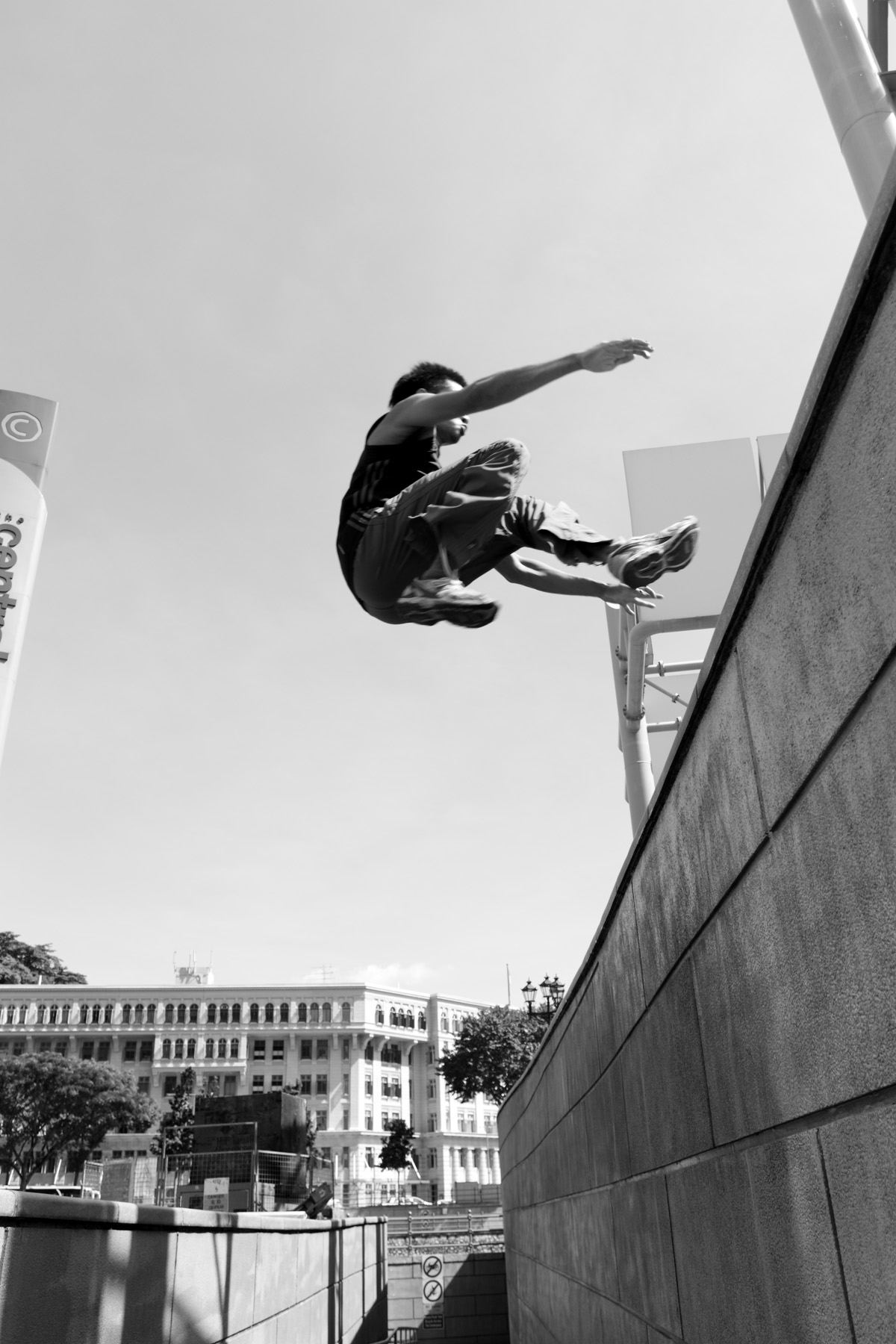
In flight: Jeffery Wong from Vancouver, Canada, CC BY 2.0
Speed: a race against the clock
In a speed event, every athlete runs the same course, from a start line to a finish, and the fastest time wins. The course is a maze of walls, boxes, bars and gaps. Athletes study it during an inspection period and plan their route, because finding a smarter line through the obstacles can save more time than raw running speed.
Speed rounds are thrilling to watch because the margins are tiny. A single hesitation before a vault can decide a medal.
Freestyle: judged artistry
Freestyle is closer to a gymnastics or skateboarding routine. Athletes get a set amount of time on an open course and choose their own movements and lines. A panel of judges scores the run on things like difficulty, flow, creativity and execution.
The best freestyle runs link many movements together without stopping, use the course in unexpected ways and finish with clean, controlled landings.
Parkour at the World Games
Parkour appeared at the 2025 World Games in Chengdu, China, on 12 and 13 August 2025, with 24 athletes from 18 nations. Caryl Cordt-Moeller of Switzerland and Miranda Tibbling of Sweden won the speed events. Mutsuhiro Shiohata of Japan and Shang Chunsong of China took freestyle gold.
For many fans it was a first chance to see parkour beside other established sports at a major multi-sport event.
Built for safety
Competition courses are designed, built and checked by officials, with matting where needed and medical staff on hand. Athletes qualify through national and international events and warm up under supervision.
Even so, the movements are only safe for people with the right preparation. Everything on this page is performed by trained professionals. Please do not try to copy it. If parkour inspires you, start at a proper parkour gym with qualified coaches.
Reading a run like a judge
In speed, watch the route choices. Two athletes can reach the same wall in very different ways, and the smarter line often wins. In freestyle, look for flow: does the run feel like one continuous movement, or a series of separate tricks with pauses in between?
Notice also how often top athletes play it safe. Knowing when not to attempt something is a skill that coaches value as highly as any spectacular jump.
- In flight: Jeffery Wong from Vancouver, Canada, CC BY 2.0
Text written by Legendary Awesome.